BMI Calculator
Calculate body mass index and category.
01 Overview
About BMI Calculator
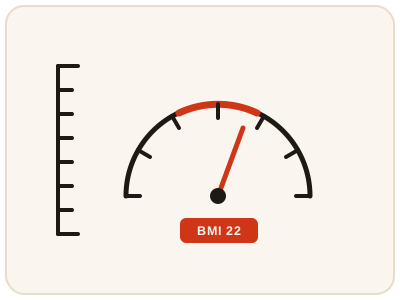
BMI Calculator turns your height and weight into your body mass index and shows which category it falls into — underweight, healthy weight, overweight or obese. BMI is widely used as a quick, general screening measure for adults, and the result appears immediately from just two numbers. Remember it is a screening tool, not a diagnosis: it does not distinguish muscle from fat, and it does not account for age, pregnancy or certain medical conditions. Treat it as a starting point for planning, not medical advice — if you have health concerns, speak to a qualified professional. It runs in your browser; your height and weight never leave your device.
02 Workflow
How to use BMI Calculator
- 1Enter your heightAdd your height in the units the tool asks for.
- 2Enter your weightAdd your current weight as recently measured — a small error in height changes the result noticeably, so double-check both figures.
- 3CalculateSubmit your height and weight to calculate your BMI.
- 4Read the value and categorySee your BMI together with its category, and repeat over time with updated measurements if you want to track change.
03 Good to know
Frequently Asked Questions
What is BMI and how is it calculated?
Body mass index is your weight in relation to your height. The calculator divides your weight by the square of your height and matches the result to a standard category range.
Is BMI accurate for athletes or older adults?
Not always. Very muscular people can score high despite low body fat, and older adults may score lower despite higher body fat. Use BMI alongside other measures, such as waist size and overall fitness, for a fuller picture.
Should I act on my BMI result alone?
No. BMI is an estimate for general guidance, not medical advice. If the result worries you, or you are planning a major change to diet or exercise, check with a healthcare professional first.
Are the healthy BMI ranges different for Asian and South Asian people?
Yes. The WHO's general healthy range is 18.5 to 24.9, but for South and East Asian populations health risks rise at lower BMIs, so several countries use adjusted cut-offs: overweight from 23 instead of 25, and obesity from 27.5 instead of 30. This tool uses the general WHO bands, so if you are of South Asian descent, treat a BMI above 23 as the point to pay attention.
What is a healthy weight for my height?
Multiply your height in metres squared by 18.5 and by 24.9. At 170 cm, that is 1.7 × 1.7 × 18.5 = 53.5 kg up to 1.7 × 1.7 × 24.9 = 72.0 kg. Any weight inside that band gives a BMI in the healthy range — there is no single ideal number, and the band itself is the target.
Is BMI the same for men and women?
Yes — the formula and the WHO adult cut-offs are identical for adult men and women. Women naturally carry a higher share of body fat at the same BMI, which is one reason BMI is a rough screen rather than a measure of body fat. A result should be read alongside waist size, activity and general health, not on its own.
Can I use this BMI calculator for my child?
Only for the number itself. For ages 2 to 19, a BMI must be compared with age- and sex-specific percentile charts, because the same BMI means different things at different ages — a BMI of 18 is healthy for a fifteen-year-old and high for a five-year-old. This tool applies the adult bands, so for a child use a paediatric BMI percentile calculator or ask a doctor.