Roman Numeral Converter
Convert numbers to and from Roman numerals.
01 Overview
About Roman Numeral Converter
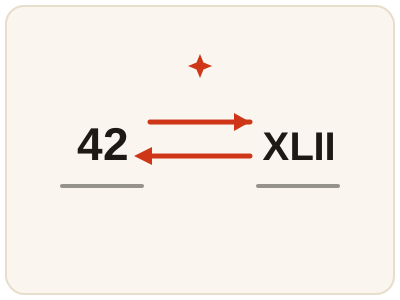
Roman Numeral Converter turns numbers into Roman numerals and back, so you can read or write them with confidence — clock faces, book chapters, film credits, building dates and formal invitations — including the subtractive pairs that are easy to get wrong, like IV for 4 and IX for 9. Letters stand for values (I 1, V 5, X 10, L 50, C 100, D 500, M 1,000), added together except when a smaller letter before a larger one is subtracted. Traditional numerals work best up to 3,999. Check the result before committing it to print, stone or skin. It runs in your browser; your values never leave your device.
02 Workflow
How to use Roman Numeral Converter
- 1Enter a number or a numeralType the number you want to convert, or the Roman numeral you want to decode.
- 2Choose the directionConvert number to numeral, or numeral back to number.
- 3Read and sanity-checkIf you entered a numeral, check the decimal value makes sense in its context.
- 4Convert back to confirmRun the result back through the converter to confirm it returns to your original value, then use the checked numeral in your design, document or homework.
03 Good to know
Frequently Asked Questions
Why is 4 written as IV and not IIII?
Roman numerals use subtractive notation to avoid repeating a symbol four times. Placing I before V means one less than five, giving 4, and the same rule gives IX for 9 and XL for 40.
What is the largest number I can convert?
Traditional Roman numerals work best for numbers up to 3,999, since there is no standard single symbol beyond M for 1,000. Larger values need extra notation, which is rarely used in everyday contexts.
Are Roman numerals still used today?
Yes, mainly for style and tradition: clock faces, monarch and pope names, book chapters, film sequels and building dates. For calculation, ordinary decimal numbers are far more practical.
What is 2026 in Roman numerals?
MMXXVI — MM for 2,000, XX for 20 and VI for 6. It is a good example of how the system builds numbers by adding symbols together, with the subtractive pairs only where a smaller symbol comes before a larger one.
What is 1999 in Roman numerals?
MCMXCIX — M for 1,000, CM for 900, XC for 90 and IX for 9. Years in the 1900s are the trickiest to read because they use three subtractive pairs in a row, so converting the result back to a number is the best way to check it.
What does XII mean on a clock face?
12. Clock faces traditionally use Roman numerals, with XII at the top, III at 3, VI at 6 and IX at 9. Four is usually written as IIII on clocks rather than IV, which is a traditional exception rather than a mistake.
How do I read MCMLXXXIV?
As 1984 — M is 1,000, CM is 900, LXXX is 80 and IV is 4. Read the numeral left to right, adding each symbol except where a smaller symbol before a larger one is subtracted, and convert the result back to confirm the total.