JWT Decoder
Decode JWT header and payload locally.
01 Overview
About JWT Decoder
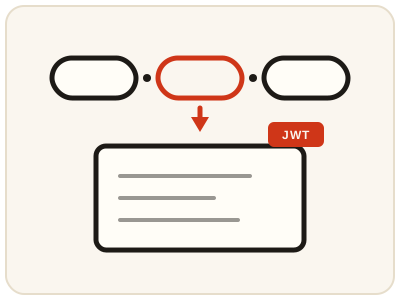
JWT Decoder takes a JSON Web Token — the three dot-separated parts you see in Authorization headers — and decodes its header and payload into readable JSON, so you can see what a token claims: who it was issued to, when it expires, its issuer, audience and roles. That is often the fastest way to understand an unauthorized error. The important limit: this decoder displays a token, it does not verify its signature — a decoded payload proves only what the token claims, never that it is genuine. It runs entirely in your browser and never uploads the token, but treat tokens as sensitive anyway and prefer test tokens.
02 Workflow
How to use JWT Decoder
- 1Paste the complete tokenAdd all three dot-separated parts, with no extra spaces or line breaks.
- 2Run the decoderThe token is split and its header and payload are decoded into readable JSON, locally on your device.
- 3Read header and payloadCheck the signing algorithm and type in the header, then subject, expiry, issued-at, issuer and audience in the payload.
- 4Act on what you findCompare the expiry with the current time if you are chasing an unauthorized error, then adjust your login flow or token request — remembering decoding alone does not prove a token is valid.
03 Good to know
Frequently Asked Questions
What are the three parts of a JWT?
A header describing the token type and signing algorithm, a payload carrying claims such as subject and expiry, and a signature that lets the issuer verify the token. The decoder displays the header and payload; it does not verify the signature.
Does decoding a JWT prove it is valid?
No. Decoding only shows what the token claims. A token can be decoded even if its signature is forged or it has expired. Only the server, using the signing key, can verify that a token is genuine and acceptable.
Why did my API reject a token that decodes fine?
Common reasons are an expired token, a wrong audience or issuer, a missing required role, or a signature the server cannot verify. The decoded payload usually points at the first three; signature problems need backend investigation.
What do the exp and iat claims mean?
They are timestamps in seconds since 1 January 1970. The exp claim is when the token expires, and iat is when it was issued. Comparing exp with the current time is the quickest check when an API rejects a token as expired.
What is the difference between a JWT and a session cookie?
A JWT is a self-contained token the client carries, and its payload can be read by anyone holding it. A session cookie is usually just an identifier that the server looks up in its own store. Both need to be handled as sensitive credentials.
Why should I not paste a production token here?
A token is a credential: anyone holding it can act as that user until it expires. Decoding runs entirely in your browser and nothing is uploaded, but as a habit, prefer test tokens and treat any real token as sensitive.
What does alg none in a JWT header mean?
It means the token claims to be unsigned, with no signature to verify. A server that accepts such a token for a protected resource would be trusting an unverified claim, so unsigned tokens should be rejected for anything that matters.