MD5 Generator
Generate an MD5 hash.
01 Overview
About MD5 Generator
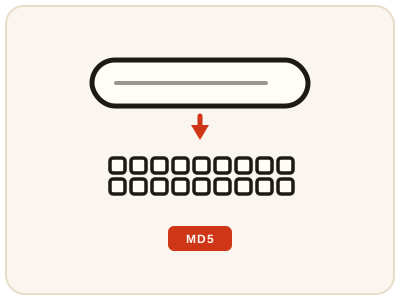
MD5 Generator computes the MD5 digest of text or a file: a 32-character hexadecimal fingerprint, the checksum long published alongside downloads and still found in old documentation, export manifests and support threads. The same input always produces the same digest, and one changed character produces a completely different one. The honest limit: MD5 is cryptographically broken — attackers can craft different inputs with the same digest — so use it only for casual, non-security comparisons, and choose SHA-256 where tampering is a real concern or for anything password-related. It runs entirely in your browser.
02 Workflow
How to use MD5 Generator
- 1Enter text or choose a fileAdd the input you want to hash, and double-check it — any extra space produces a different digest.
- 2Generate the digestThe 32-character hexadecimal MD5 output is computed locally on your device.
- 3Copy the digestTake the digest for comparison with the published or expected MD5 value.
- 4Compare and judgeMatching digests mean identical copies for practical checksum purposes. Differing digests mean changed data — obtain a fresh copy before relying on it.
03 Good to know
Frequently Asked Questions
Is MD5 secure?
No, not for security purposes. MD5 is vulnerable to collision attacks, so an attacker can craft different data with the same digest. Use it only for casual integrity checks, and choose SHA-256 when tampering is a real concern.
Can I recover the original text from an MD5 hash?
No. MD5 is one-way: the digest cannot be reversed into the input. Short, common inputs can be guessed by trying candidates, which is another reason MD5 must never be used to store passwords.
How is MD5 different from SHA-256?
Both produce fixed-length digests, but SHA-256 produces a longer 64-character digest and remains cryptographically strong, while MD5 produces a shorter 32-character digest and is broken for security use. For new work, prefer SHA-256.
What is an MD5 checksum used for?
Casual integrity checks, such as comparing a downloaded file with the MD5 value a publisher lists, and matching values in old documentation, export manifests and support threads. It is a checksum for convenience, not a security guarantee.
Why is MD5 still used if it is broken?
Because it is embedded in older systems, documentation and tooling, where the goal is only a quick non-security comparison. For those uses it still works. Where tampering is a real concern, SHA-256 is the correct choice.
How long is an MD5 hash?
32 hexadecimal characters. That fixed length is part of what makes it a fingerprint: any input, short or long, produces a digest of exactly that length.
Can I use MD5 to store passwords?
No, never. MD5 is fast to compute and vulnerable to collisions, so an attacker with stolen MD5 password hashes can guess common passwords very quickly. Passwords need a dedicated slow password-hashing method with a unique salt.